


I’ve been single for most of the decade. Since university, the number of people I would call close friends has dwindled to a select few. I work from home most of the time. My family is close but I’m also an online child. I’m proud of the life I’ve built for myself, but often I’m hit with an unavoidable wave of loneliness.
I’m an introvert, so I love being alone, when it is on my terms. There’s nothing better than sitting in a cafe with a matcha and a book, or curling up under a blanket with my dog. But sometimes I wish I had someone to share a pizza or argue about Netflix choices with.
I’ve tried a few methods of making new friends. I’ve joined those awful ‘Ladies Social’ Facebook groups. I’ve joined a gym. I’ve been on countless Bumble BFF dates. I have made some friends. But I think the digital world has broken our ability to maintain friendships, and most see friendship as a lower tier to partner.
We’re more connected than ever online, but we’re also the loneliest we have ever been. According to research by Bond University, one in three Australians are lonely. Research by Harvard University found that 30 - 44 year olds are the loneliest group. In this period of our lives, there are a lot of changes peoples lives are diverging in a way that can make old friends incompatible.
Social media can skew our sense of reality, and make us compare our social lives to what people post on the internet. If we feel like everyone else is socialising more than us, it is harder to feel satisfied with the social life we have. Dating apps expose us to a higher level of rejection than we would face in person, while also preventing people from approaching each other in real life. While texts and messaging are a convenient way to keep in touch, this type of communication lacks emotional cues that fuel connection. Loneliness is not just about physical isolation, but emotional distance. You can feel alone in a packed room or with hundreds of online connections.
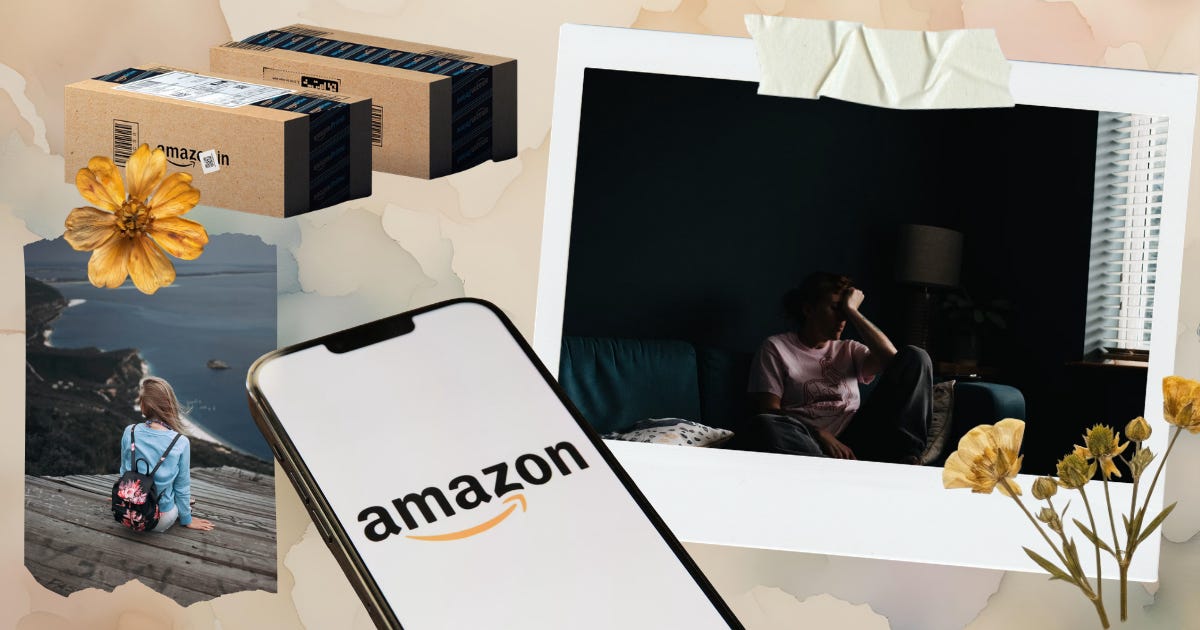
While my friends are cosying up to their partners and I’m spending another night alone on my couch, I open up Amazon. Contrary to popular belief, feelings can be purchased. But it’s more than a monetary cost. Another package arrives at the door, and sometimes I can’t even remember what’s in it. The shame hits me like a tsunami as I take a knife to the tape.
The problem with Amazon is that it promises comfort wrapped in cardboard within 1-2 days. Imagine if therapists were that efficient at healing emotional wounds. In theory, I know that buying something won’t make me feel more fulfilled, emotionally regulated or a better person. But as I’m sitting alone with a bag of Uber Eats and an algorithm to scroll, I feel like it deserves another try. Each product is a false promise of a better life. I can’t find a partner, but I can find a pair of headphones for a good deal.
Amazon has turned taking advantage of shopping addiction into a science. The site is perfectly optimised to make sure you think as little as possible about making a purchase. They’ve thought about everything from the wording of the buttons to the colours of text in listings. Even the ability to cancel is a scam. I’m much more likely to make a purchase if I know it’s reversible. Amazon have whole teams dedicated to making the experience more addictive and more successful in short circuiting our ability to stop ourselves from making impulsive purchases. I know it’s a machine, but the beast pulls me back.
We’re also consuming more advertisements than ever before. Before social media, advertisements were reserved for commercial breaks on television, and pages of magazines. It seemed like advertisements had their place in the world, which was easy to avoid. The more I see people pose with products, the more I feel like I’ll reach the same level of happiness if I just buy, buy, buy.
Now it’s not just advertisements we need to be aware of. It’s user created content. There’s influencers promoting ereaders and workout tights. But there’s also a photo of someone you barely remember from university standing in front of a new car with a big bow. It’s your cousin’s friend posting photos of her wedding, while tagging every vendor. It seems that every life achievement comes with a product placement.
A couple of years ago the algorithm got me with Stanley cups. I felt like a Stanley cup would make me healthier, brighter and more hydrated. I couldn’t start my new healthy life until I had one. But I didn’t just buy the cup. I purchased straw covers, charms, and even a silver insert with my name. I was sucked into the algorithm and spat out with a bunch of extra plastic. Worst of all, I was still lonely and in debt, even if a bit more hydrated.
I don’t remember when I became addicted to Amazon. Maybe it was the pandemic. The combination of being stuck inside with only housemates and a daily walk is enough to drive anyone to Bezos. My shopping addiction started before then, but at some point it shifted from walking around shopping centres to Amazon Prime. At least I was getting some exercise! Now, when I’m bored and alone, I doomscrolling through Amazon, Depop and Etsy as if a purchase would answer my prayers.
In my 30s, most of my friendships don’t resemble what I had at university and school. Friendships are based around on shared experiences, like the lecturer you hate or studying for an exam together. It’s harder to recreate that when our lives as so fractured, even though we seem so connected on social media. I think some of us are trying to create that shared experience on social media. When you open TikTok to fifty videos of Chappell Roan’s minor faux pas, you can feel like you’re in on something that only the chronically online know about. This extends to products. When I had a Stanley, I was part of a secret club of people changing their lives with an insulated water carrier.
Another thing that’s missing from modern friendship is the experience of spending time together without an aim or scheduling restriction. My best friend and I like to have ‘do nothing hangs’ where we sit in my lounge room and parallel play with books or gaming consoles. There’s a bit of chat, but mostly just appreciating being together. ‘Do nothing hangs’ are a hard sell to most people in their 30s, splitting their time between friends, children, work and meal prep.
We’ve become victims to catch up culture, where we occasionally sit together over a hot beverage and spit out life updates that aren’t already on social media. Every time this happens, I just remember the friendship we used to have. I think about the long gossip sessions after a night out, complaining about an exam and sitting in silence together in the library. More yearly coffee catchups would just fuel the fire to loneliness.
I’m fighting the pull of Amazon by leaning into connection and creation, even if it’s small. I’ve joined a great gym that’s full of wonderful women moving for their minds. I’ve got a loving family and group of friends, even if they’re small. I’m writing about my addiction and reading about consumerism, loneliness and lost connection. I don’t think anyone is reading it, but writing is cheaper than sending more money to Jeff Bezos.
I am such an introvert I couldn’t relate more. I spend most of my time in my home. With my cats. I have a boyfriend who I live with but he understands i’m not a huge fan of talking all the time, so often we just sit in each other’s company in silence. It’s very nice. But before him, I would do something similar. I ended up subscribing to a Book of the Month to help fill the void. But man, amazon really does a great job at replacing friends or a partner. It so accessible and easy to use and has literally anything you could possibly think of from couches, to ice cube trays, to school supplies, to CRISPR kits. It’s all at the tips of your fingers. Everything is. Which is great! But also a slippery slope.
You're a great writer. The addiction to the buzz of new 'stuff' that will equate with a new you is so relateable. I wrote an article on my thrift addiction that touches on similar themes - you might like it.
I loved this line: "I was sucked into the algorithm and spat out with a bunch of extra plastic."
Subbed and supporting your writing over shopping journey! :)