


Last year it was Labubus. This year it’s Mystery Dumplings. Little squishy coloured balls with a surprise variant in each box. In Australia, Bunnings, a hardware store, briefly sold blind box bears in different home improvement related outfits.
It seems like blind boxes have captured the hearts of adults and children online. Are these harmless collectable toys, or gambling cloaked in brightly colour plastic? What about simulated gambling in games like Roblox and Overwatch? Are these innocent games and toys, or is gambling being pushed on children?
Blind boxes
Pop Mart sold over 100 million units of Labubus in 2025. But the product was an explosive, short-lived trend. By March 2026, Pop Mart had suffered a $33 billion loss in market value. The most expensive Labubu was a 5 ft mint green monster, selling for $170,000 in Beijing. Labubus inspired a range of accessories, such as clothing and plastic cases. Labubus are synonymous with consumerism, fleeting trends and being ‘chronically online’, but the impact of blind boxes on children could be more insidious.
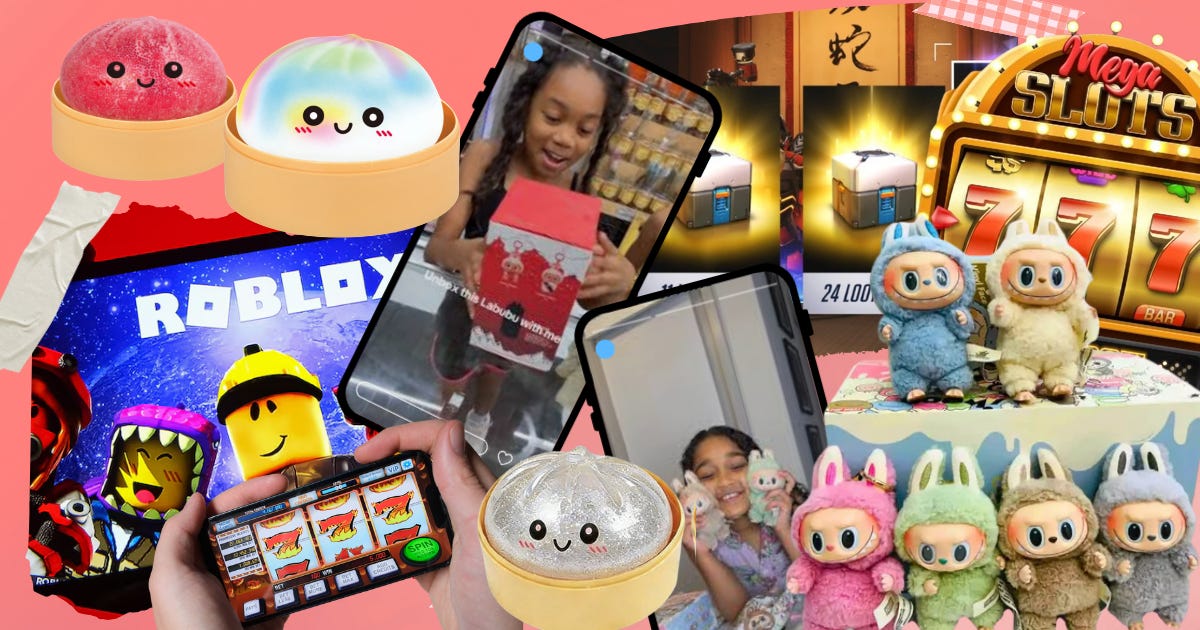
Blind boxes are toys in sealed opaque packaging. Usually you could open the packaging to find variations of the toy, some more rare or valuable than others. Furry little monsters called Labubus first became popular in 2024. Buyers lined up around blocks to buy Labubu boxes. Videos of adults and children reacting to opening their Labubus went viral on YouTube and TikTok. How could buying little furry monster toys possibly be a form of gambling?
Gambling describes the practice of wagering or betting something valuable on a random event with the goal of winning something else valuable. Usually gambling involves betting money to win more money, but this isn’t always the case. Let’s apply this to blind boxes. Someone purchases a blind box hoping that they will be rewarded with a rare or valuable toy. Like roulette or blackjack, it’s a game of chance without any strategy involved.
According to researchers, the emotional states triggered by opening a blind box are similar to those experienced by people gambling on poker machines. The thrill of gambling and blind boxes is the possibility of a big win. You could find the rare toy, or be disappointed with something more common. Blind boxes create pressure for consumers to collect the whole set, and find the elusive mystery toy. Then consumers get online and create free advertisements in the form of unboxing videos.
Parents would never introduce their children to poker machines. But brands are encouraging the same build of anticipation of a random result with blind boxes. Randomised rewards are also featured in promotional marketing campaigns, such as McDonalds Monopoly and Woolworths Ooshies. Even competitions like the Wonka Golden Ticket smell a bit like gambling.
Gaming
I remember gambling being a feature of some of the games of my childhood. I remember a shopping centre in a Pokemon game which had a whole room of slot machines. Certain Pokemon could only be bought with game tokens. I also played Neopets, which had a bunch of gambling games from dice games to wheel of fortune. Here’s an old article with the best ways to gamble on Neopets.
Gambling has remained a fixture of children’s gaming, but now players are spending real money. Apparently 40% of young people play video games with gambling components. Simulated gambling in games use similar sounds and actions to poker machines, but do not allow players to win or lose real money. However, players can use real money to purchase game currency to play the game.
Games like Overwatch and Star Wars Battlefront II allow players to purchase ‘loot boxes’ which contain a bunch of randomised items. Prizes could include character skins, weapons or other advantages. Items won in games are not only useful in gameplay, can be sold to users for game currency, or traded for other items. When I was playing Neopets, my main goal was to obtain a rare ‘paintbrush’ which could either be used to decorate my Neopet or sold on the Trading Post for Neopoints.
Loot boxes have been banned from the popular game Roblox for users under 15, but the game still allows random reward mechanics for these users. Some of the most popular Roblox games allow users to purchase items of randomised rarity, which they can later use or trade. How can we expect children to understand the concepts behind these games, like statistics or risk?
Jake Paul controversially promoted created real-life loot boxes. In his Youtube video, I Spent $5,000 ON MYSTERY BOXES & You WONT Believe WHAT I GOT… (insane), Paul opens a virtual box over and over, revealing different products. Sometimes he wins AirPods, and sometimes he wins a charging cable. A few minutes in he’s throwing up his hands because he’s won an iPhone. Then he builds his own customised box for over a thousand dollars. After winning Apple Watches and Yeezy shoes, he creates a new box that gives him a 0.15% chance of winning a Rolls Royce and 99.85% chance of winning Adidas shoes. The box costs $1,133.79. Of course, he wins the shoes valued at $130. Paul’s core viewership is children and young teenagers.
Pushing kids to gamble as adults
There’s not much research on the impact of blind boxes on children. But researchers have found links between using claw machines and coin pushers to having problems with gambling in adulthood. This research indicated correlation not causation, and USA based participants recollected using one of these machines at least once in their childhood. Thestudy did not consider how often a child used one of these machines.
Many research studies have found a link between simulated gambling in video games and gambling issues in adulthood. It follows that allowing children to use real money to play games with randomised reward mechanics can translate to gambling in adulthood.
Game developers have used randomised reward mechanics to replicate the most addictive elements of gambling. There’s enough reinforcement and near misses to keep kids playing the game. The immaturity of a child’s prefrontal cortex makes them more susceptible to the tricks of simulated gambling. Game developers are not subject to the same regulations as the gambling industry, which allows them greater control over outcomes.
Researchers have argued that randomised reward mechanics should be banned from children’s games. This begs the question, how pervasive is simulated gambling in children’s games? Children & Media Australia has compiled a Children and Gambling Watch List. I was not surprised to see entries like Big Fish Casino, Bejeweled Blitz and Bingo. But there’s also games like 8 Ball Pool Barbie Dreamhouse Adventures, and Uno! Gambling has infected a wide range of console video games and iPhone games targeted at children.
We should be targeting childhood gambling with regulation. Singapore has proposed laws around blind boxes, which may require manufacturers to disclose the odds of each variant. But would that really stop children, who have little understanding of statistics?
In 2024, the Australian Government introduced new classifications to games featuring simulated gambling. Despite changes to classifications, games with simulated gambling remain accessible to children. For example, Roblox is only classified as ‘PG’ in Australia.
Worried your child could be exposed to simulated gaming? Research the games they are playing, especially if game currency can be bought with real money. For app games, check Children and Gambling Watch List. Parents should reconsider buying, and allowing their children to watch unboxing videos online.